|
vs. Nature
|

We rarely stop to think that the night is necessary and good for life. Therefore, we do not realize that protecting the night sky is a valuable step to conserving bio-diversity. Most people think that, as we sleep at night, the rest of the species do the same, with a few exceptions, so it is of no concern if we send out a little light into the night time environment. A crass error. Naturalists know (and it would help if they said so more often) that the biological activity of our fauna is more intense at night than during the day and that this fauna needs the night for their normal activities.
-- The Importance of Protecting the Night Sky
Pere Horts
Deputy Chairman of Cel Fosc. Catalonia. Spain
Light Pollution Harms the Environment
For a billion years now, multi-cellular life on this Earth has existed with a regular and dependable day-night
schedule of illumination levels in the environment. This regularity is ingrained into the DNA of species up and down our evolutionary
tree to our biological advantage. Natural light entrainsor regularizes basic and fundamental biological activities across species from plants to us humans. The effects of light pollution on plants and animals in the environment are numerous and are becoming more known over time. In general, the most common action is that light pollution alters and interferes with the timing of necessary biological activities. For approximately half of all life, those crepuscular and nocturnal species that begin their daily activities at sundown, our artificial lights at night seriously constrain their lives, exposing them to predators and reducing the time they have to find food, shelter, or mates and reproduce. To assume that other living organisms on this planet are just going to "adapt" to our newly created lighting schedules for commericial convenience is apathetically ignorant and insane. Unfortunately, it is far, far easier to setup a badly installed light outside than it is to understand the negative effects it casts down-light from it. For example, U.S. roadways contribute a huge amount of waste light. All of that bad lighting could be redone by replacing the up-pointing 300W halogen bulbs with more efficient LED lights and by pointing the LEDs downwards. Overtime, this would cost far less for the taxpayers without causing a single change in the quality of information delivered to the traveler or to compromise their safety. Such lighting seems especially wasteful as headlights on cars are more than sufficient to light up signs, so the lights are not truly needed at all now. It must be understood that white light sources, such as metal halides, CFLs or LEDs, must be used with caution! These lights emit high levels of bluish light that not only interferes with our night vision and our own health, but also with the well-being of animals. Other types of lighting, such as incandescent or high pressure sodium vapor lamps, produces high levels of reddish or even infrared light. Their spectra interferes with the well-being of many types of plants. So no living species ever evolved to take advantage of continuous lighting. We should not be surprised that no species truly benefits from it in the long run. |
|
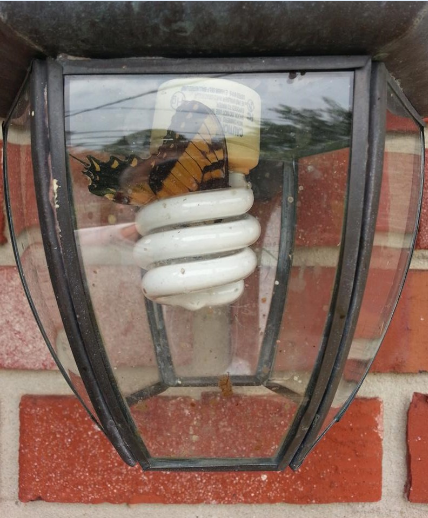
However, bad lighting does not stop just at the roads. Tiffany Saleh wrote a good article on the "Effects of Artificial Lighting on Wildlife" explaining this in the WildlandsCPR.org's web site.
This page provides an organizational overhead to some of the impacts that light pollution has on different
species which have lived on this planet far longer than us "john-come-lately" humans. The dark blue menu column on the left will
also help you navigate these pages as they grow.
In the span of a mere one hundred years, our creation of a never-occurring night
is having some real effects on the animals that were here before us. For the same melatonin suppression problems we have with lights
at night, creates similar problems in animals. Melatonin is the chronobiotic
hormonal regulator of neoplastic cell growth, meaning that it is just the hormonal signal of our biological clock
, is used for
such functions in mammals worldwide. Biologists describe it as being the most evolutionary conservative hormone
that we know
of, meaning that it is one of the oldest hormones known across the tree of life that basically signals to genes and organs whether it
is daytime or not. Hence light pollution affects animals as well. A mere glance at the articles in the
Light pollution vs. Human Health pages easily confirms this fact as melatonin testing is done
over and over on rat species. In fact, it is found in almost all organisms.
But melatonin is more than just some ancient hormone buried deep within us and the animals that is being impacted. Night tells so many animals when to eat, when to sleep, when to hunt, when to migrate or even when to reproduce, it is estimated that half of all life on earth start their daily activities at sundown. Here is a brief, incomplete accounting of how light pollution harms those living outside our materialistic world.
Our Vanishing Night -- YouTube video by astrogirlwest
| Light pollution: its real, destructive consequences are seldom recognized, but it is a problem with easy solutions that make economic sense. All living creatures rely on the Earth's regular rhythm of day and night to regulate internal cycles. Many use the protection of darkness to safely forage and mate. We exist in a balance with our environment, a delicate balance that we are shifting. In the process we are also losing our connection to the night sky and the universe beyond. |
FLASH: A new study reports that lights on at night can worsen smog conditions for a city! Sunlight breaks down the nitrate radical NO3, so its levels build up during the night. As it does so, it neutralizes some of the other nitrogen oxides (NOx) that contribute to smog. But it is not just sunlight that can break down NO3; any light can do this, especially those city lights that are left on all night long. Streetlights are often immediately next to the sources of the exhaust creating smog and are measured to be about 25 times stronger than the light of a full Moon. This combined effect reduces the natural cleaner NO3's levels down by 7%, which then increases the smog components by a non-negligible 5%.
Details can be found at http://www.skyandtelescope.com/astronomy-news/night-lights-worsen-smog/.
Now add to that the practice of additional outdoor lights on for the holiday season ...
Click below to additional pages covering effects of light pollution on plants and animals in:
- Mammals
- Birds
- Reptiles
- Understanding, assessing, and resolving light-pollution problems on sea turtle nesting beaches.
- Behavior of Loggerhead Sea Turtles on an Urban Beach. I. Correlates of Nest Placement
- Behavior of Loggerhead Sea Turtles on an Urban Beach. II. Hatchling Orientation
- Do Embedded Roadway Lights Protect Sea Turtles?
- Shots from the Front on the Beach
- Sea Turtles Have Color Vision!
- Amphibians
- Insects
- Plants
- Links to Other Sites
The old Lakota was wise. He knew that man's heart away from nature becomes hard; he knew that lack of respect for growing, living things soon led to lack of respect for humans too.
-- Chief Luther Standing Bear
Links to Other Sites
The Florida Fish and Wildlife Conservation Commission has their own pages about light pollution effects on various biological organisms. Check them out as they are in the field, obseving these effects directly!
The SkyKeepers.org out in California has their own Ecological Light Pollution page covering additional articles and reports on the effects of lights at night and the environment.
Florida Atlantic University
Boca Raton, Florida
E-mail: evandern at fau dot edu
Phone: 561 297 STAR (7827)