|
|
Astronomical Observatory
FAU Observatory



Florida Atlantic University Astronomical Observatory
FAU Observatory -- Front Page
Welcome to the Observatory's Front Page. Included here are some of the latest news and articles that may be of interest to our visitors. General observatory information, such as location and Google maps link, viewing schedules, Events Calendar, contact information, student class credits, directions and parking and other general information, can be found on the "About the Observatory" page.
We also have a growing coverage about the issue of light pollution, what it is, what it does to the environment, to ourselves, to our wallets and resources, to our security and safety, to the majestic wonders of the night sky and what YOU can do about it. This is a man made problem that is prepetuated by a lack of awareness and is something that we all can correct.
The Front Page
The Front Page currently covers:
|
|
News of FAU Observatory
= = = N O V A W A T C H = = =
Corona Borealis or the "crown north" ("CrB"), is a faint constellation of a circlet of stars that lies midway between the star Arcturus in the constellation of Boötes and the "keystone" of Hercules. To find them, first locate the Big Dipper and note that its handle is "arced". Like the old saying goes: "Follow its arc to Arcturus, then spike south to Spica". Arcturus is a bright orange star on the image's lower left. The constellations in the region are faint. You should easily see the bright white Vega in the sky to match it on the image. At the end of March, the constellation CrB rises above the ENE horizon at 10:30 pm and reaches the meridian at 4:30 am. Expect those times to shift 4 minutes earlier each night, so that it'll be two hours earlier each month going forewards. So, by the end of April, it'll rise by 8:30 pm, and so on.
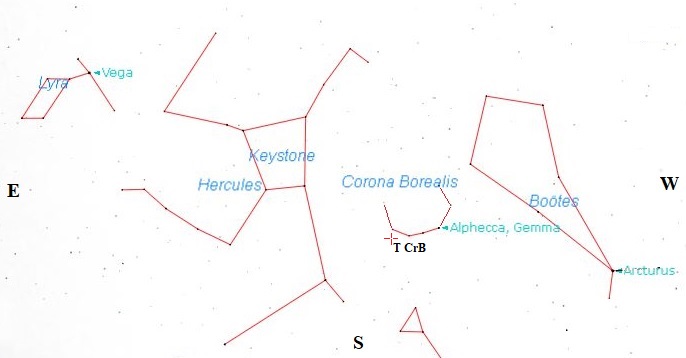 |
| The image shows the general region of the sky to help find the constellation of Corona Borealis. The Big Dipper would appear north of this view and to the west (so, to the upper right of the image). Print it out, go out at night, and hold it up as you are facing south. Observe it now, to become familar with the region before it briefly changes. |
In the direction of CrB, is a gravitationally bound, binary pair of stars, which has a red giant star that is being orbited by a white dwarf star. This system is called T Corona Borealis or "T CrB" for short, as indicated on the image above. It seems that the white dwarf is in a accretion disk surrounding the red giant star. AND in doing so, the dwarf star has been gaining mass.
When white dwarf stars gain enough mass, they have two reactions. Either they 1.) "ignite" that acquired surface mass in an instant fusion reaction explosion, like an "H-bomb/firecracker", that we call a NOVA. The PBS TV series has been hearlding the concept in its opening title movie for decades. Or 2.), they go supernova, type Ia. At its estimated distance of 806 pc (2628.85 ly), based on the numbers I can find, if the dwarf star were to go supernova type Ia, then it would appear in the sky with a brightness to have an apparent magnitude of mv=−9.77. It would NOT be as bright as a full Moon, but it would be brighter than the historic supernova of 1054 that everyone in the world saw (except apparently, for western Europe, which has no mention of it anywhere in its records!). The radiant light from this potential supernova would be concentrated from a single dot in the sky and certainly be bright enough for people to notice, even in the full day time. It would only do so, while the white dwarf is close to the necessary "Chandrasekhar limit" to do that, but its not quite there, yet.
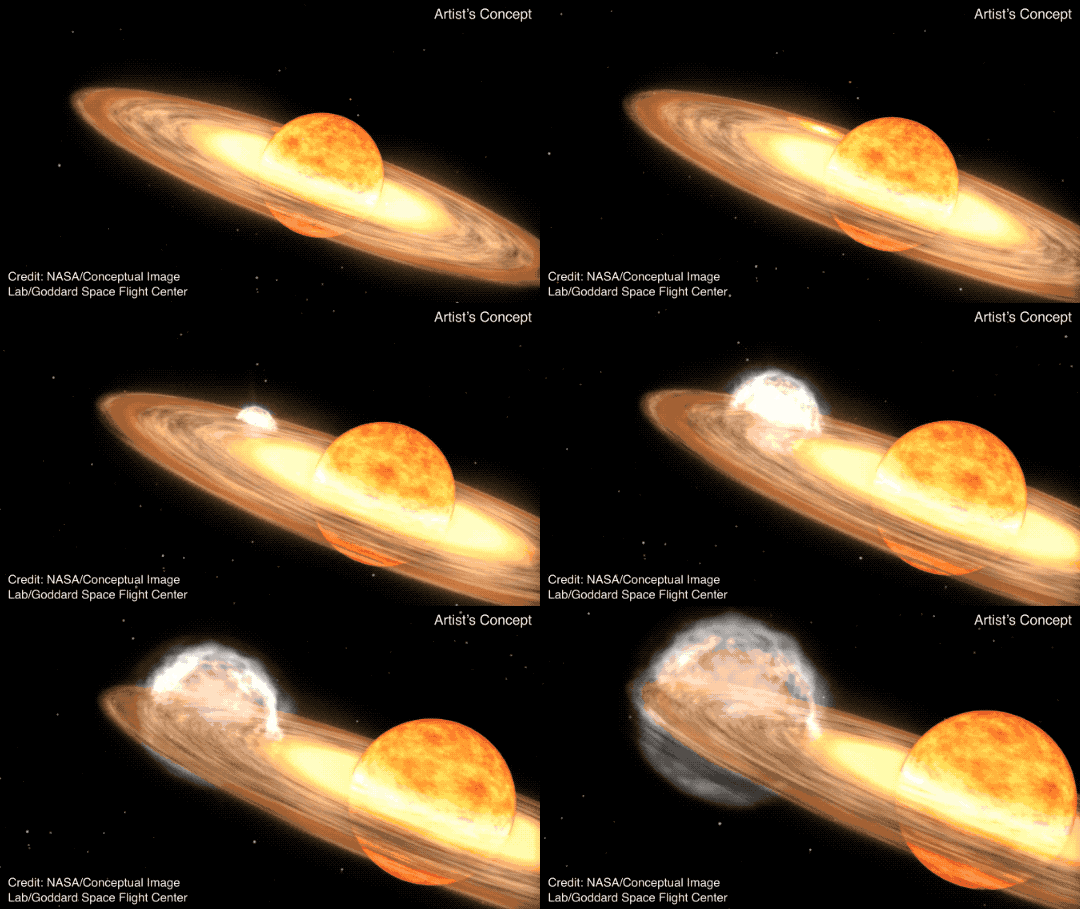 |
| A red giant star and white dwarf orbit each other in this animation
of a nova. The red giant is a large sphere in shades of red, orange, and white, with the side facing the
white dwarf the lightest shades. The white dwarf is hidden in a bright glow of white and yellows, which
represent an accretion disk around the star. A stream of material, shown as a diffuse cloud of red, flows
from the red giant to the white dwarf. The animation opens with the red giant on the right side of the
screen, co-orbiting the white dwarf. The view shifts to the side as a nova explodes on the white dwarf.
The flash fills the screen with white light. After the light fades, a ball of ejected nova material is
shown in pale orange. A small white spot remains after the fog of material clears, indicating that the
white dwarf has survived the explosion. Credit: NASA’s Goddard Space Flight Center |
So, we expect to witness the 1st reaction, in that, T CrB will go Nova soon. Estimated this year, between March and Septemer, of 2024, with a greater chance occuring in April and/or May. There are patterns to T CrB's brightness, from its last flare up in 1946, that are being repeated again now. Hence, we expect it soon. And consider this, the system is so far away from us, that if that 78 year period is consistent, then the light of 33 more flare ups have already been released and are on their way to us right now, if it hadn't already gone supernova!
So, when precisely, will it arrive, you may ask? Well, we don't exactly know.
The amount of matter that falls on the white dwarf is not a clean, precisely known rate of accumulation. Its natural and chaotic, and so in that, it is kind of acts like the weather. But what we expect to see will be from a seemingly small blank part in the constellation's region (big telescopes can see it, but naked eyes cannot), the star will flare brightly enough to rival the north star Polaris, within a few short hours. The brightening will brief, just like any other big firecracker, in just a couple of days or up to perhaps a week, it will have faded back to obscurity for another 78 years. Which makes this once-in-a-lifetime event much rarer to see than a passage of Halley's Comet. For you see, that comet comes around every 75.5 years and when it will do so in 2061, people will be able to see it all summer long in the northern sky then. T CrB's period is a little longer and its appearance will be much shorter. So, it is rarer to see.
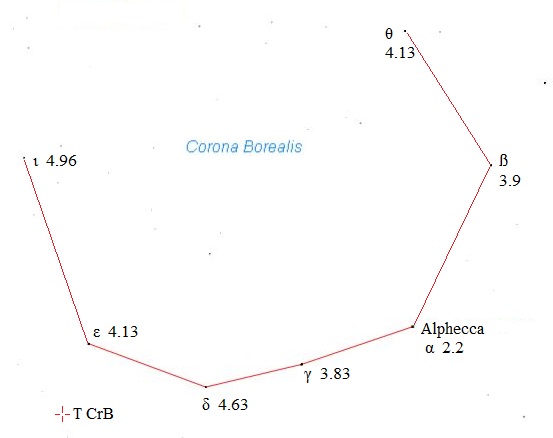 |
| This image is a close up of the constellation of the stars of Corona Borealis with their averaged apparent magnitudes. The magnitude numbers just give you a way to compare the brightness of the stars against each other. By our modern way of looking at it, the magnitude numbers "go backwards", in that, the dimmer the star, the greater the number. The stars' Greek letters, clockwise from the upper right, are pronounced as: Theta, Beta, Alpha, Gamma, Delta, Epsilon, and Iota. Look for T CrB outside the circlet, near Delta and Epsilon. |
And so, we watch and await for its appearance. You can print out the accompanying images to help you find the region in the sky. I recommend that people go out and look at the region now, before it goes off, so that when it does flare up later, you will be able to appreciate the appearance of a "new star" in the sky. At least, for that week, before it fades away. I am working on setting up a method to broadcast announcements about it when I see it do so and plan to open a special obseration session when it happens so that people can come as see it for themselves, too.
The April 24th Update: Still checking on T, but no change yet.
BUT as it keeps rising earlier every night, it's now doing so while neighbors are walking their dogs. Met a
couple doing so last night, told them about it's potential appearance, and how to find it. They were quite
interested in it.
If any of you are trying to check on T, as well, then please do share what you know
about it with others. That way they can share it's wonder and excitement, when it happens, too!
The April 15th Update: It's not T's time yet! So far, nothing new to report. The nightly change of the rise time for the constellation is easier to deal with. Tonight, expect Corona Borealis will rise about at 9:20 pm.
The April 8th Update: I'm still going out each night to look for T CrB, but nothing, so far. It may not seem like it at first, but the nightly change of the constellation's rise time is quite noticeable. If you go out, expect that Corona Borealis will rise at 9:50 pm.
The April 1st Update: I have been going out every night to observe the appearance of T CrB outburst, but so far, nothing yet. I'll get some pictures of the region soon. If you try to go out, expect that Corona Borealis will rise at 10:10 pm, so its geting easier to check on.
General Sky Conditions
Solar conditions, atmospheric phenomena and news are reported by www.SpaceWeather.com.
The current sky conditions of Boca Raton are found via the Clear Sky Clock:

And some details as to what this means is mentioned in the
Visiting Tips section of the About the Observatory page.
Basic weather conditions for our area are at www.wunderground.com forecast for Boca Raton, while our astronomically important current cloud cover conditions can be found at www.wunderground.com for Boca Raton.

|
Check out: the Space Telescope Science Institute's Sky Tonightmovie at Amazing Space or to Sky & Telescope's This Week's Sky at a Glancepage. |

|

What's Up in the Sky! |
Section updated: Feb. 5th, 2024 |
The Sun Today:
The Sun currently swims with the fishes of Pisces since March 11th. It will be there in Pisces, that on Monday, April 8th, it will get occulted by our Moon during its TOTAL SOLAR ECLIPSE. The excitement and buzz of this upcoming event has been building and folks are making plans to travel to and be in the path of totality across the U.S. from its entry into the country in western Texas, passing up and through south Illinois, Cleveand, Ohio, Buffalo, NY, and exit the country in north Maine.
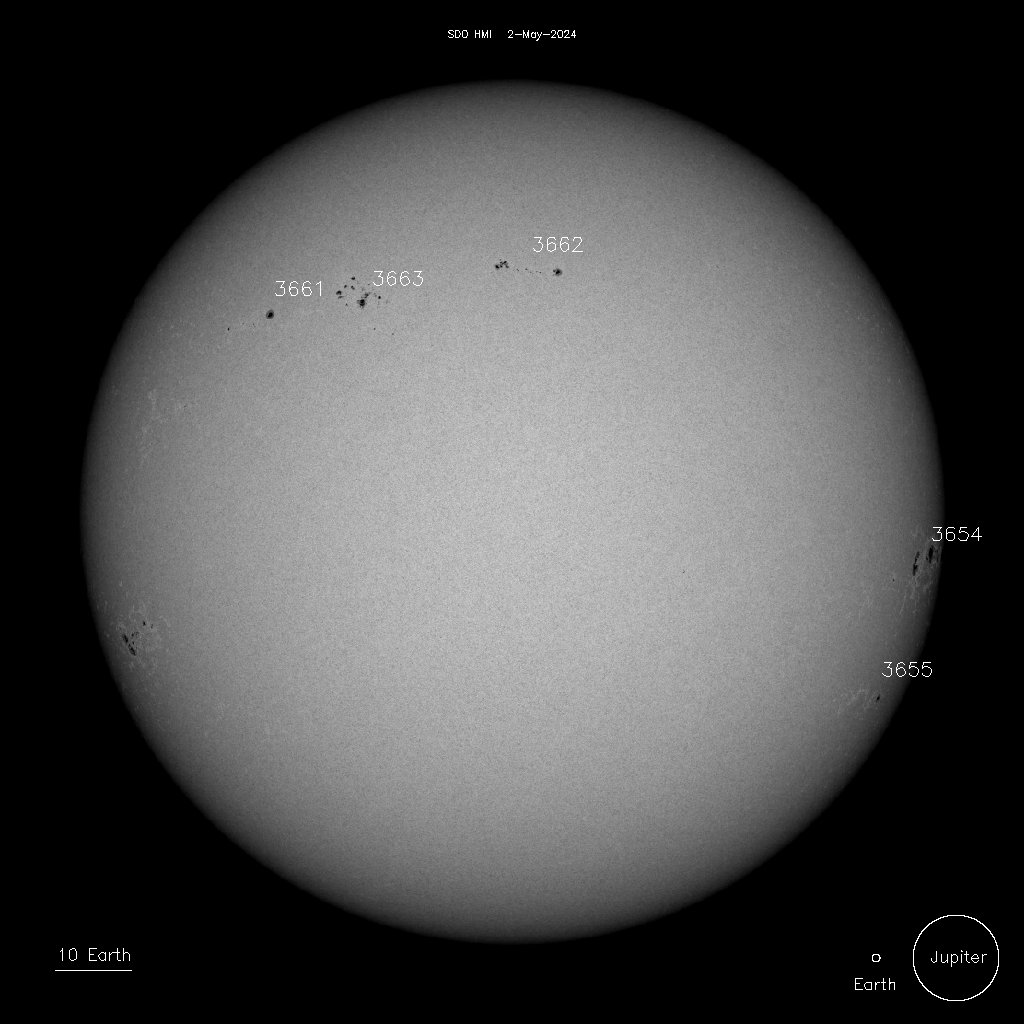
Visual Sun |

Link to current images of the Sun in Hα light goes to those provided by the |
From www.n3kl.org |


Lunar Phases:
|
|
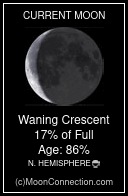
Total eclipse comes soon, with a low quarter Moon!
Imagine two dancers that hold hands and spin around each other on the dance floor. They will both see the other appear to move in the same direction to their sides. The Earth orbits around the Sun in its own "dance floor" or orbital plane. As we do so, it appears to us that every day the Sun changes its position in the sky and moves toward our East direction.
The Moon also orbits about the Earth in its own orbital plane. Its plane is tilted to our own by 5°. Just as a wall and ceiling makes a line at their 90° intersection, so these two orbital planes intersect and cross through each other. In doing so, they make the "Line of Nodes". We see these planes intersect twice each year. And each year, the Moon's orbital plane progresses westward, so that intersecting Line of Nodes occurs earlier by 18 days from the year before. In 2025, that Line of Nodes intersection will happen incredibly near the "first point of Ares" in Pisces, which defines the "origin point" for celestial coordinate system of right ascension and declination that we use to find distant stars and celestial bodies in our sky. It'll be a "Super Astro/Mathematical Convergence of Coordinate Systems" when it happens! Unfortunately the Moon will be over 93° away when the Sun gets there then, so, it will "miss the party". Such a convergence won't happen again until 2034, but I'm getting ahead of myself! Much more often than not, the Moon and Sun do not simultaneously appear together at the Line. BUT when they do, it is in their straight "syzygy alignment" with the Earth, is when we experience eclipses. These events have been so profoundly important to us, that the Sun's apparent orbital path in the sky, and so our own orbital plane is called the "Ecliptic", as it was named after the eclipses that are seen there. Eclipse seasons occurs twice a year and as the planes are tilted by only 5°, then the season can last almost for a month around a perfect solar eclipse.
The syzygy alignment occurs only at a new or full Moon phase. Hence, in order for them to get into that alignment, then the Moon's quarter phases must be positioned as far above or as far below the ecliptic as the Moon can be. So, at sunset on Mar. 17th, go outside and look for the Moon. The Ecliptic will be especially high then, nearly as directly overhead in South Florida as it can get. AND with the Moon's orbital tilt north of the Ecliptic then, the Moon will actually appear even further north than overhead, by 2.5°, which is nearly 5 lunar diameters! An angular change that almost anyone could notice. So, as we get closer to 1st quarter phase, note the phase AND how far north it appears. Likewise, note how LOW and far south the 3rd quarter Moon at sunrise on April 2nd will be. Those observations right then tells you that you are in an eclipse season, giving you a glimpse of the hidden geometry of the Moon's orbital plane! Somewhere in the world people will experience eclipses once the Moon continues on and crosses the Ecliptic a week later. That little rhyme above may help people learn to know what to look for and recognize its significance of what they see. Go observe then, so that you may enjoy a thrill of understanding of the mysterious celestial mechanics that are about us!
Perhaps even enough to spin and twirl about in a celestial dance of your own!
Meteor Showers: |
Section updated: Feb. 5th, 2024. |
Note: compare shower dates with Moon for favorable viewing conditions; the fuller the Moon, the harder it will be to see the meteors!
| Peak Night | Name | Radiant's Location | Source | Zero Hour Rate | Meteors' Velocity | Description | Conditions |
|---|---|---|---|---|---|---|---|
| Apr. 22-23 | Lyrids | between Lyra & Hercules | comet C/1861 G1 Thatcher | var. up to 90, ave. 18 | 49 km/s | quick, brighter than ave. meteors, ~1/5 w/ trains | Full Moon! |
| ~Apr. 23 | Pi Puppids | south of π Puppis | comet 26P Grigg-Skjellerup | up to 38, on 26P's perihelion yrs | best seen in far south | ||
| May 6-7 | Eta Aquarids | η Aquarius | comet 1P Halley | 55-var. | 66 km/s | fast, brighter than average meteors | Great! |
Viewing Tips: Find a decent location away from obstructive lights in night, especially
avoid bluish-white lights that so impact your nightvision capabilities
which you'll need to see the fainter meteors! The meteors are generally heaviest in the wee hours of the morning
as then we'll be in front of the Earth as it plows it way through the debris trail
. You'll want a clear and
unobstructed view of the sky as you can find as the meteors will appear to travel across the entire sky. It is this is
reason that an observatory, like FAU's, is a poor choice to go to observe a meteor shower. An even worse place to go would
be a cave! In South Florida, I often advise folks to try the beach, though please be VERY careful during sea turtle season!
Egg nests or little hatchlings can be easily crushed by clumsy feet. Use
only red LED flashlights if you go to the beach to not only avoid stepping on these reptiles, but the color also protects
your night vision (and of course your night time circadian rhythm, too) so that you can see the show. Bring a blanket, use
bug spray, get comfortable and enjoy the view!
Additional details about meteors, showers or to REPORT your own fireball observations should be done via http://amsmeteors.org.
Solar System Planets: |
Section updated: June 15th, 2022. |
Little Mercury is found in Taurus the bull just east of the Pleiades and west of the Hyades in its direct motion. On July 6th, Mercury will finally exit Taurus and go travel through the playground of the Gemini twins. If you can get up on June 26th, you'll see it, Venus and a very thin cresent Moon all together that morning. Mercury will hide beyond the Sun at its superior conjunction on the 16th of July. After that, it flips back to the western twilight sky.
Venus will soon enter the pasture of Taurus the bull on June 17th. A month later, it will enter into the Twins's playground and then on to the tide pool of Cancer the crab on Aug. 10th. It will slowly get lower and lower as the year progresses as it will be on the far side of the solar system at 1.59 au away and appear closer to the eastern horizon. And get lower still by Aug. 27th, as it enters the realm of Leo the lion and be 1.64e au away. While it may become harder to see depending on how clear your eastern horizon is, it is worth a try.
For as Venus will be on the far side of the Sun, what observers will see of it through a telescope will be a "full phase", like a full Moon, of its surface. It was this type of observation that Galileo made years ago that was the crucial piece of evidence he needed to prove that the Earth was NOT the center of the universe. Because the only way we can clearly see such a phase of Venus is if it was beyond the Sun and not orbiting only some midpoint between the Earth and the Sun, like how Ptolemy had once declared. Galileo pointed out that if Ptolemy was correct, and not Copernicus, then all we could ever see through a telescope would be a crescent phase of Venus, as we would always be looking mostly at its nightside as Ptolemy thought it could only exist between us and the Sun.
Venus will reach superior conjuction with the Sun on Oct. 17th, then be 1.71 au away from us and beyond the Sun as it will later appear on the flip side of the night and begin appearing in the western twilight sky by November.
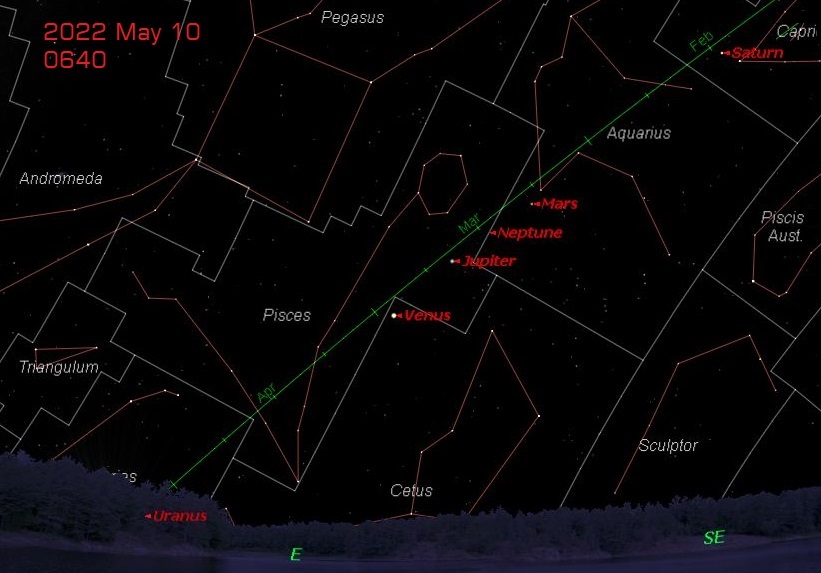 Planets of the Eastern
morning sky 2022 May 10.
Planets of the Eastern
morning sky 2022 May 10.
How do you know what you are looking at is a planet? Well a simple check is to see if it twinkles.
Stars twinkle, planets don't. Stars higher in the sky twinkle less, however, the closer they are to the horizon, the more twinkle
they appear to do. While planets, like Venus, will appear to be a steady light source. As of May 2022, Venus is moving to the far
side of the solar system, so through a telescope, expect it to show a waxing gibbous phase (more than half of it appears lit to us
and shaped like an oval). Though it is getting further away, its high albedo (much like white paper, it has a high ratio of
reflected light to what it receives) is why it appears so brightly.
NEWS-FLASH: On May 4th, NASA reported the biggest Quake ever recorded ON ANOTHER PLANET: MARS!

NASA reported the biggest quake ever recorded on another planet, the planet MARS! It registered 5.0 on the Richter scale and was recorded with its Insight seismometer on May 4th. Which luckily came to it before it will have to shut down the monitoring station due to the amount of dust collecting on its solar panels, depriving it of the necessary light energy needed to run its instruments. Still, the station and its seismometer lasts twice as long as they were engineered to do! So well done there! Jump from here to read more about it on NASA's JPL pages.
If you are looking for Mars, the active old warrior appears in the early morning skies marching eastwards in the constellation of Pisces the fish. On June 22nd, the waning crescent Moon will pass it by. Mars will march on through Aries the ram's pastures on July 9th, and will get passed by the waning crescent Moon again, but mostly in the daylight hourse. Mars will then confront Taurus the bull on Aug. the 10th and try to dash across his pasture! . But by Oct. 31st, Mars will begin traveling westward in his retrograde retreat. As he does so, the planet will appear brighter and brighter until it reaches its opposition to the Sun on Dec. 7th.
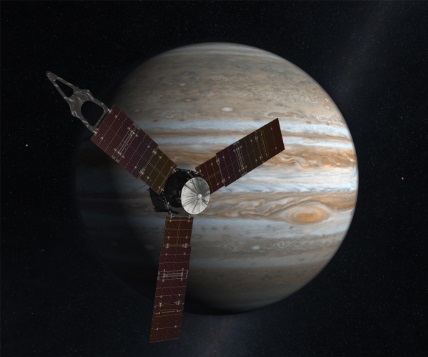 Jupiter,
the jovial king of the sky is retrograding in the constellation Pisces. This will be particularly interesting retrograde
to watch for on Sept. 26th, Jupiter will reach opposition to the Sun. This will NOT be an ordinary opposition, though,
because it will occur when Jupiter is near its perihelion. Meaning that Jupiter will be only 3.9525 au away from
us that night and so be closer to us than it will be again for the next 12 years!! Views of it through the telescope
will be great to see and we will be holding an event for it then. On the 26th, Jupiter's moons will be far to its side and be
hard to appreciate in the telescope. However, at least on the 23rd, Io will pass in front of the giant planet, this will help
show its celestial motions AND we'll get to spy its Great Red Spot too then. More details above.
Jupiter,
the jovial king of the sky is retrograding in the constellation Pisces. This will be particularly interesting retrograde
to watch for on Sept. 26th, Jupiter will reach opposition to the Sun. This will NOT be an ordinary opposition, though,
because it will occur when Jupiter is near its perihelion. Meaning that Jupiter will be only 3.9525 au away from
us that night and so be closer to us than it will be again for the next 12 years!! Views of it through the telescope
will be great to see and we will be holding an event for it then. On the 26th, Jupiter's moons will be far to its side and be
hard to appreciate in the telescope. However, at least on the 23rd, Io will pass in front of the giant planet, this will help
show its celestial motions AND we'll get to spy its Great Red Spot too then. More details above.
Saturn appears in Capricorn, prograding through the sea goat. It will stay with the goat for the rest of the year. On Aug. 15th, it will be at opposition and only 8.8569 au away from us and have an apparent magnitude of 0.28, almost rivaling of what we see of the star Vega.
Uranus is currently in Aries the Ram's meadow, north of what I consider to be the fluke of Cetus. Traditionally, that part was seen as the "sea monster's head" and the southern part, its body. Yet, if you turn around the thinking, the constellation of Cetus actually looks like its name. For "Cetus" is where we get the word "Cetacea", which is the order of marine mammals, such as whales. To me, the northern part is like the fluke, while the southern part is body, head and mouth of the whale, just like a humpback or blue whale. Uranus will be with Aries until near the end of May 2024.
Neptune is in his element straddling between the border of Aqurius and Pisces and will stay around that area for the rest of the year.
Dwarf planet Pluto appears in the northeastern corner of Sagittarius, not near any bright star. Its opposition is July the 17th. Pluto will stay in Sagittarius the archer's range until March 2023.
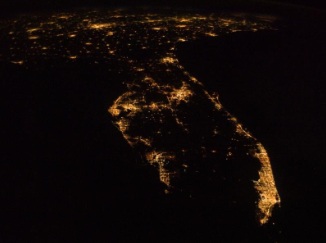
Can You Identify This Image?
Florida Atlantic University
Boca Raton, Florida
E-mail: evandern@fau.edu
Phone: 561 297 STAR (7827)