Section updated: September 28th, 2026.
The month of October 2026 will be filled with astronomical and Observatory events.
Friday’s October 2nd: 🦉 FAU Owl Family Weekend
We will be a part of FAU’s Owl Family Weekend for families and students to spend time together and enjoy what FAU has to offer. Details at: https://www.fau.edu/newstudent/family/weekend/.
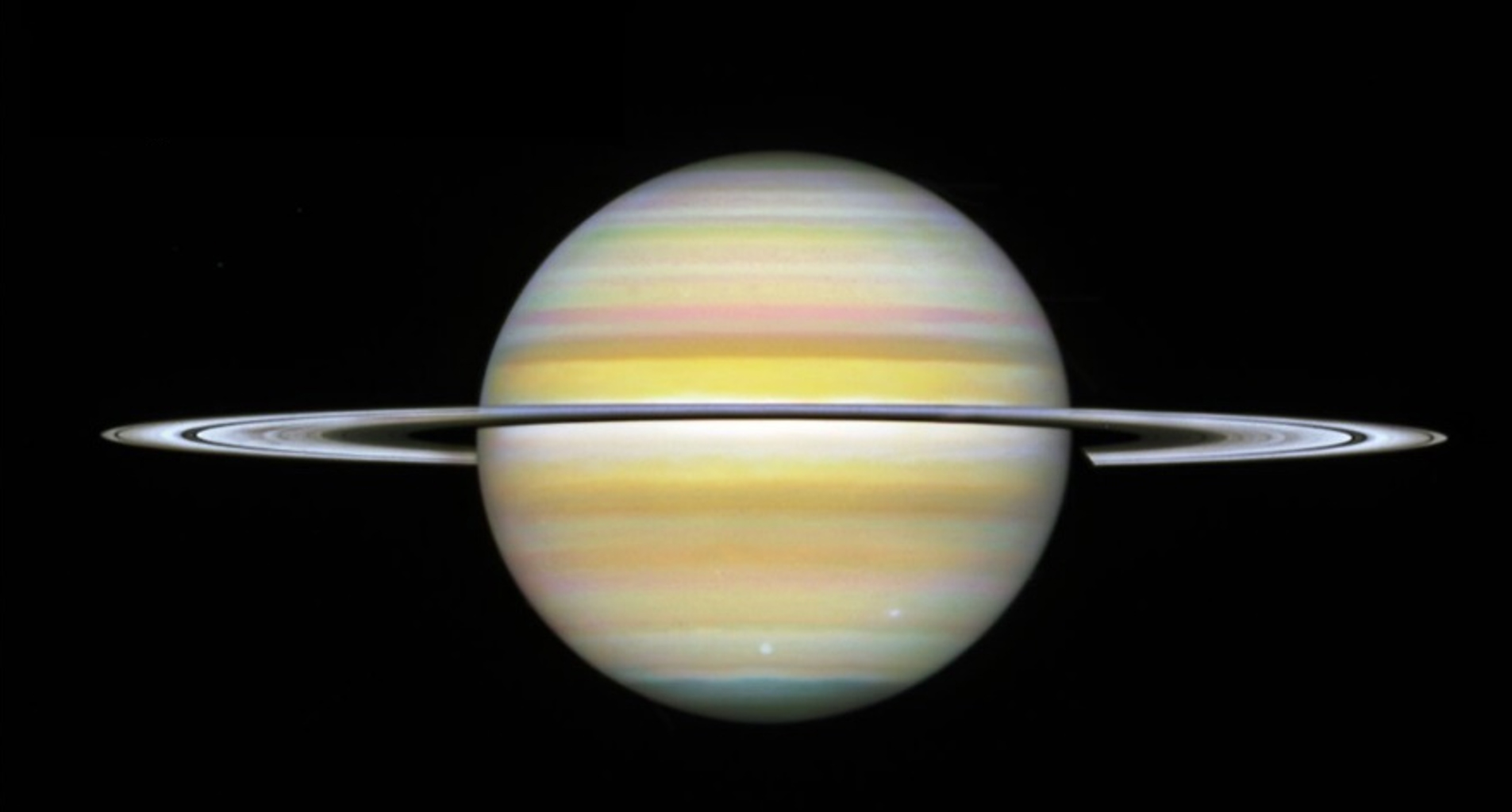
Sunday October 4th : ♄ ☉☍ Saturn's Solar Opposition
The Earth reaches a perfect opposition syzygy alignment between Saturn and the Sun at 8:04 am. It'll be 8.434 au away or almost exactly 70 light minutes away from us then. The Observatory will focus on this "Planet of Geometry" on Friday, October 9th.
Tuesday, October 6th : 🌘 ♃☌ Moon Jupiter Occultation
You may want to get up pre-dawn at 4:20 am until 5:11 am and look due east to witness the waning crescent Moon occult or pass in front of the planet Jupiter. Each time, the Moon will take nearly 80 seconds to complete each part.
Thursday, October 8th: 🌠 Draconids Meteor Shower
Coming from a radiant next to the head of the northern constellation Draco the dragon, the Earth scoops up particles from the comet 21P Giacobini-Zinner. The numbers of its meteors are variable, ranging from 0 to storm. The meteors are somewhat bright but very slow, traveling only 20 km/s. Lunar conditions are ideal for viewing them.
As the meteors will appear to travel all across the entire sky, you'll want a dark, clear and unobstructed view of it that you can find. So go far away from city lights to see them. In South Florida, I often advise folks to try the beach, though please be VERY careful during sea turtle season! Use only red LED flashlights as the color also protects your night vision (and of course your night time circadian rhythm, too) so that you can see the show. Bring a blanket, use bug spray, get comfortable and enjoy the view!
|
August 29th, 2025
|
Friday, October 9th : 🔭🪐 Public Viewing Session We will feature the “Planet of Geometry” (a.k.a. Saturn) for the evening of our public viewing session and discuss why it should be called as such. You can find it right below the green line for the ecliptic, between the constellations of Aquarius, Cetus and Pisces, is where we will find the planets Neptune and the “Planet of Geometry”. |
|
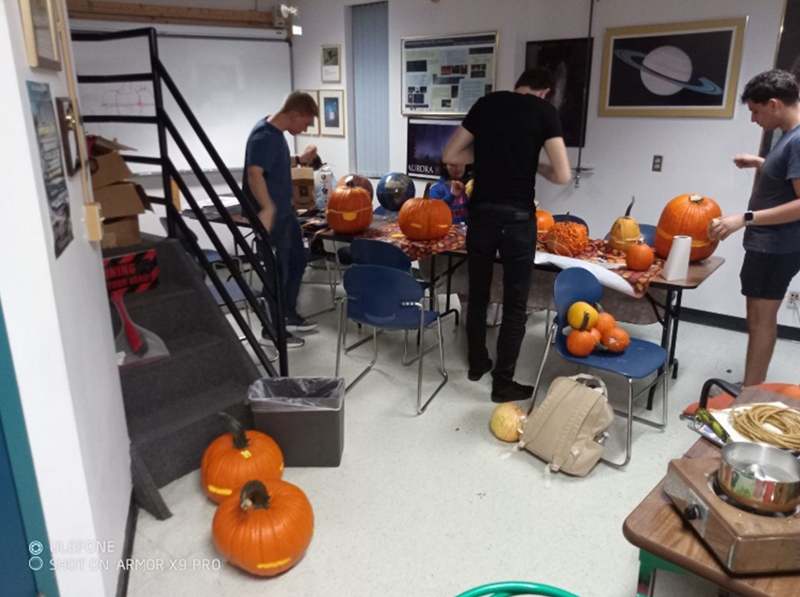
October 22nd: Pumpkin Preparation Night Every year for the Physics Department’s Pumpkin Drop, we prepare the pumpkins for the next morning’s event. Aristotle once claimed that heavier things fall faster than lighter ones. Galileo countered that by saying “Wrong! Two objects of the same shape and density should fall at the same rate to the ground, even of different masses.” Nor should it matter, Galileo argued, if objects were loosely or tightly tied together, their fall rates would remain the same. Well, showing this with pumpkins is challenging as pumpkins do not have the exact same shape, and their centers are hollow, which alters their densities. So, we prepare the pumpkins by filling them with water and cut notches into their shells, to securely tie cords to them so they won’t slip off and fall when we are not ready for them to do so for our various demonstrations. It all gets quite messy, though, but here is a peek of our work the night before the drop. |
|
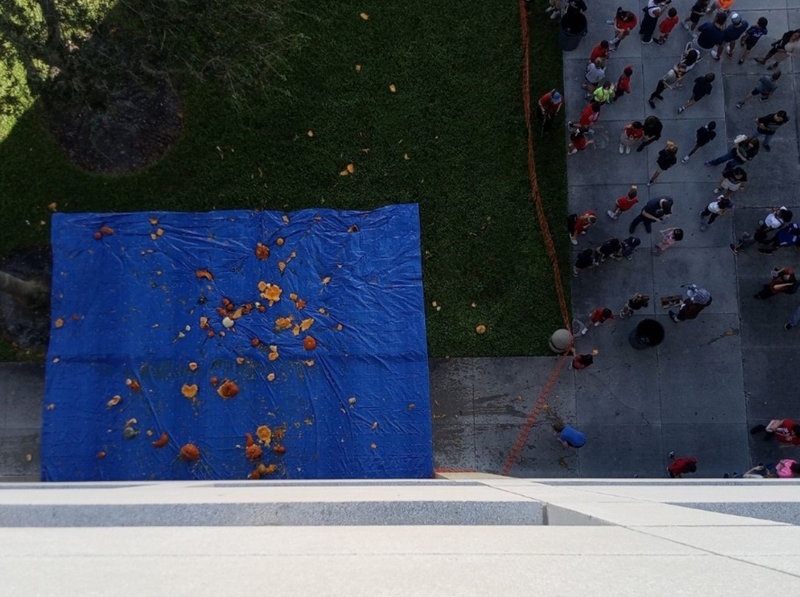
October 23rd: Physics Department’s Carnival and Pumpkin Drop Here’s what I see of our mess below from the roof after all the pumpkins have been released. The water filled pumpkins make an exciting and very satisfying explosion on impact for our Pumpkin Drop! Look out below! ♀ ☉☌ Venus Inferior Conjunction, 11:48 pm Also, during the Carnival part of our day’s event, will be an inferior conjunction of Venus and the Sun. This daytime event occurs as the planet Venus passes right in front of us in its orbit. We will be as close as we can be to it, but only be looking at its night side, if we tried to look for it through the blue daytime sky for it. Afterwards, expect to find Venus on the flip side of the night in the pre-dawn, eastern horizon sky. |
Target Observations for Tuesday’s October 27th’s Session:
Below is shown what our sky would be like by 8:30 pm on the 27th. The night sparkles with its multitude of interesting, wondrous objects of our Galaxy for us to see. Shown below as the light orange circles for globular clusters such as M13, light blue patterns of 5 dots are open clusters, and cyan crossed circles are planetary nebula in the image, though they are challenged by the light pollution from the surrounding cities. While right below the green ecliptic line, between the constellations of Aquarius, Cetus and Pisces, is where we will find the planets Neptune and the “ Planet of Geometry ”. The Full Moon will be finishing its transit across M45, the Pleiades open star cluster.
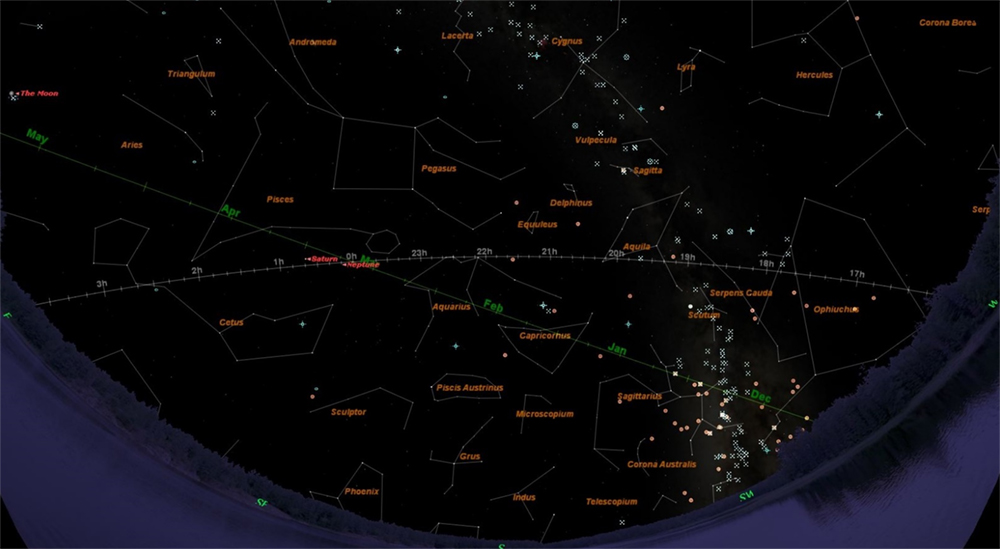
Among the variety of things to explore are the globular clusters of NGC 5897 in Libra, M5 in Serpens Caput, M13 & M92 in Hercules, and M10, 12 & 14 in Ophiuchus, M4 in Scorpio and M22 in Sagittarius. Open clusters NGC 6802, called Brocchi’s Cluster (a.k.a. the “Coat-hanger cluster”) in Vulpecula the fox, NGC 7662 in Andromeda, The planetary nebula of the “Saturn Nebula” NGC 7009 in Aquarius, M57, the Ring Nebula, in Lyra near the star Vega, and the “blinking planetary nebula” NGC6826 in the constellation of Cygnus the swan. We will also spy on its apparent, binary star called Albeiro, the swan’s beak, which are colored blue and gold, like the Ukrainian flag.