Light pollution: Any adverse effect of artificial light including sky glow, glare, light trespass, light clutter, decreased visibility at night, and energy waste. Light pollution is not only a hinderance to astronomy, but it also impacts us directly.
Light pollution:
We have welcomed many different groups to come to visit our observatory, from school classes, to extracurricular groups and day camps.
On cloudy days or evenings, we will still offer lectures or video presentations to our visitors.
For those that can not make our Public Viewing events, there are various astronomical viewings available through out the state, to the public, such as in:
Section updated: Jun. 2nd, 2026
The Sun is safely passing through the pasture of Taurus the Bull.until it reaches its solstice position, when it crosses into Gemini region. It stays with the Twins until it splashes into the watery realm of Cancer the crab on July 21st.
|
Visual Sun |
Link to current images of the Sun in Hα light goes to those provided by the |
Solar X-rays: Normal Geomag. Field: Storm From www.n3kl.org |
|
|
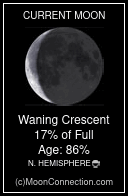
Blue Full Moon | May 30th | ||
| Last Qtr. Moon | June 8th | |||
| New Moon | June 14th | |||
| 1st Qtr. Moon | June 21st | |||
| Full Moon | June 29th | |||
| Last Qtr. Moon | July 7th | |||
| New Moon | July 14th | |||
| 1st Qtr. Moon | July 21st | |||
|
|
Full Moon | July 29th |
Section updated: Jun. 2nd, 2026
Note: compare shower dates with Moon for favorable viewing conditions; the fuller the Moon, the harder it will be to see the meteors!
|
Peak Night |
Name |
Radiant’s Location |
Source |
Zero Hour Rate |
Meteor’s Velocity |
Description |
Conditions |
|
~June 27 |
Bootids |
Northern Boötes |
comet 7P Pons-Winnecke |
var., 0-100 |
18 km/s |
very SLOW, bright meteors |
Moon challenges |
|
Aug. 12-13th |
Perseids |
Perseus |
comet 109P |
100 |
59 km/s |
fast, bright |
Excellent! |
|
~Sep. 1st |
Aurigids |
Auriga |
C/1911 Kiess? |
6 |
66 km/s |
fast, some |
Pre-dawn |
|
~Sep. 9th |
Epsilon |
ε Perseus |
? |
5 |
64 km/s |
fast, some |
Can do! |
Viewing Tips: Find a decent location away from obstructive lights in night, especially avoid bluish-white lights that so impact your nightvision capabilities which you'll need to see the fainter meteors! The meteors are generally heaviest in the wee hours of the morning as then we'll be in front of the Earth as it plows it way through the debris trail. You'll want a clear and unobstructed view of the sky as you can find as the meteors will appear to travel across the entire sky. It is this reason that an observatory, like FAU's, is a poor choice to go to observe a meteor shower. An even worse place to go would be a cave! In South Florida, I often advise folks to try the beach, though please be VERY careful during sea turtle season! Egg nests or little hatchlings can be easily crushed by clumsy feet. Use only red LED flashlights if you go to the beach to not only avoid stepping on these reptiles, but the color also protects your night vision (and of course your nighttime circadian rhythm, too) so that you can see the show. Bring a blanket, use bug spray, get comfortable and enjoy the view!
Additional details about meteors, showers or to REPORT your own fireball observations should be done via http://amsmeteors.org.